

Spin Down by Liam Hogan

Chief engineer Julia ‘Roddy’ Rodrighero could almost forget she was the only human aboard the Clarion. Monitoring a swarm of drones, she was engrossed as they pirouetted through hard vacuum, stripping the last sections of C-Deck. One of those exposed, honeycomb chambers had been hers, six months ago.
She had roomier quarters these days, though less of the colony ship to roam. No endless circular walks around B deck’s outer promenade, no clatter of trays in the dining halls, no drone ballet in the zero-g hub. Lightly strapped to her operator’s chair, it was all zero-g now, and those agile drones had a bigger arena to fill, whether anyone was watching or not.
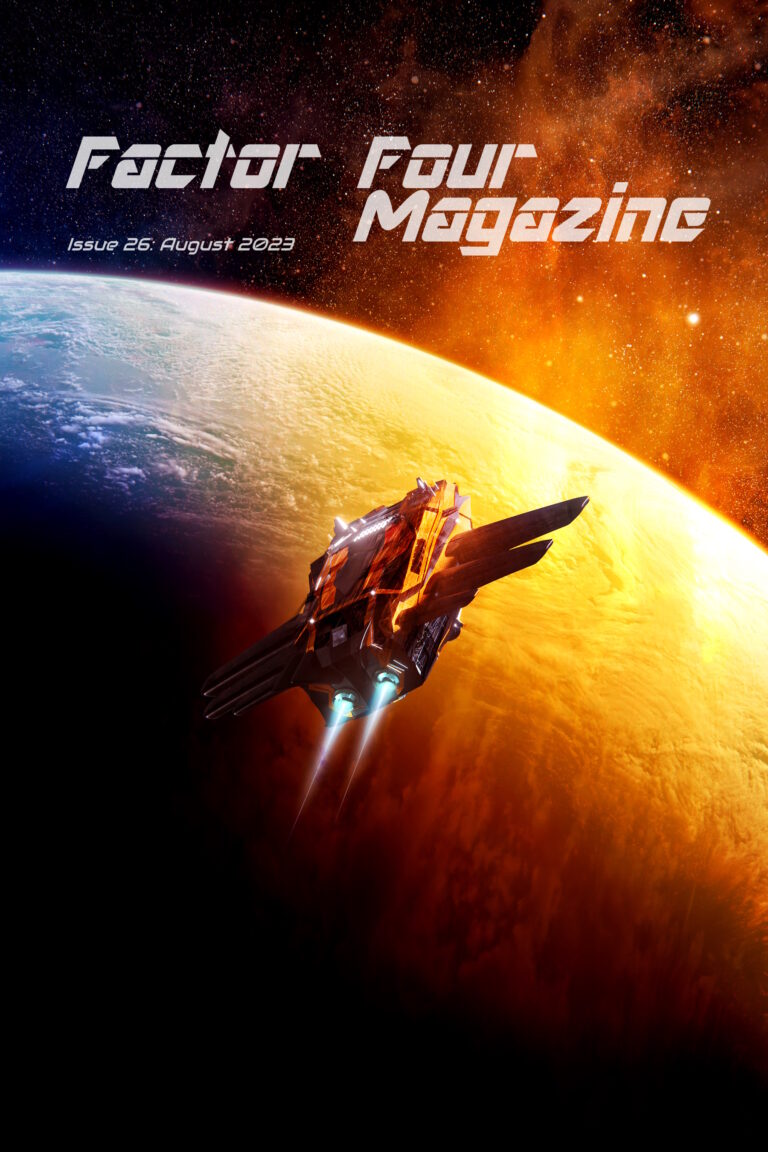
The Clarion was an ethereal husk, a bare-bones skeleton. A ghost of its former, immense self, steadily dismantled since their arrival at Gliese 1002b. Little left but the massive, now redundant interstellar engines, the superstructure, and the control deck, where Julia kept track of proceedings and where Clarissa, Clarion’s enmeshed AI, was housed. It would be echoingly empty, if most of it wasn’t airless.
The Clarion’s vast holds had been unloaded first. Food supplies, water purifiers, tools, seeds, and pampered livestock. Then the shielding and internal structure had been peeled like an onion. Building materials, for planet-side habitation and workshops; observation windows becoming greenhouses, miles of pipes turned into irrigation. Everything that could be removed and sent down the gravity well had been, and the colony had enough high-strength, lightweight fabric, deployed as drag parachutes on cargo sleds, to last a couple of centuries, as roofs, awnings, even clothing.
The planet below, renamed Silesia, wasn’t perfect. Large stretches were hopelessly arid, and they’d had to genetically tinker with plants used to a yellower sun. But it was better suited than they had any right to expect. A quiet world, under a quiet star.
“Clarissa, drone 72 is showing a pressure drop in port attitude adjusters.”
“I am aware, Ms Rodrighero, thank you.”
Of course Clarissa was aware. On a day to day basis, Julia was as redundant as those mighty engines. But that would change, over time, as ship systems became harder to repair, necessitating hacks and fixes only human hands could effect.
By then, most of the drones would be planet-side. Repurposed, since jets of compressed nitrogen didn’t do much against gravity or atmospheric pressure.
Julia buzzed Captain Blake, to let him know the shuttle was prepped. When he appeared on screen, the red orb of a dwarf sun setting over his shoulder, he gave her an easy grin.
He always had been a handsome devil.
“How’s it looking up there, Roddy?” he asked.
A dusty brown globe, a sparkling inland sea, both cut in two by the encroaching night. “Beautiful as ever, Captain. Shuttle’s ready to descend.”
A pause, and a small frown. “I know we’ve discussed this, ad nauseum, perhaps. But I have to ask again.”
Julia nodded, she’d been expecting this.
“The remaining drops will be unpowered, this is the last shuttle run. Your final chance to join us.”
“And give up that big bed of yours?”
Captain Blake laughed, then shook his head. “Seriously, Roddy.”
“Seriously.”
“Well. Had to check.”
“You did,” she agreed. “But no. I’ve made my decision, and I’m content.”
Julia’s age was the fly in the ointment. The treatments that the Captain and everyone else had taken, to bridge the gap between the colony ship’s half-gee and the Silesia’s 1.1 Earth gravity, had not been tolerated. Her old bones hadn’t strengthened the way they should.
Now there wasn’t even half a gee; the Clarion fully spun down, the rotation an obstacle to its deconstruction. She would only get weaker, frailer.
When she had been offered the choice, planet, or orbit, her life expectancy was five years planet-side, tops. Though her bones might still strengthen a little, it wouldn’t be enough to protect her from breaks. The gravity would crush her, slowly, and painfully.
Aboard the Clarion, she might live as long as another twenty years. Ten was more probable, with no-one to care for her, should she get ill. She was kind of hoping not to.
Content just about summed it up. She knew the Clarion as well as anyone, with the notable exception of Clarissa. Julia had always found it easier getting to grips with machinery than people. And while engineers were needed to build the new colony, they had lots of them, younger, less fragile. Julia had, she would claim, too much to unlearn to be of much use.
She hadn’t been the only colonist with medical issues. Hearts and bones. It was why the on-arrival population skewed young. Heck, if Clarissa was being hard-nosed and pragmatic about it, every colonist past breeding age, with the possible exception of the figure-head Captain, should be spaced. A deadwood burden for a colony during its most precarious stage.
Julia was deadwood too, whether down there, or up here. The Clarion had been designed to operate autonomously, even stripped bare. Though one person didn’t make all that much difference, and an experienced human aboard actually boosted the rump ship’s predicted longevity, by a fraction. So claimed the AI. Julia hadn’t looked too closely at the numbers.
“You and I, Clarissa. You and I,” she muttered.
There were, of course, other AI’s already on the planet surface, from handhelds to science stations. Capable of communicating with the Clarion whenever it passed overhead, a dazzling dot that on first landing could be seen even at noon, but had faded as it was cannibalised. It was still the brightest thing in the sky once the sun set.
The Clarion would remain in orbit. Providing vital data about their new home, dispatching reports light-years back to Earth. And Julia would remain with it, doing whatever she could to keep Clarissa and the core systems ticking over, for as long as possible. Trying hard to forget that she was the only human aboard.
This was such a wonderful read.